

While Halloween today brings to mind costumes, trick-or-treating, and spooky decorations, its origins are deeply rooted in ancient traditions. Halloween, as we know it, comes from the Celtic festival of Samhain (pronounced “Sow-in”), celebrated in pre Christian times in Ireland and some parts of the British Isles. Samhain marked the end of the harvest season and the beginning of winter – a time when widely believed that the boundary between the living and spirit worlds was blurred.
What Was Samhain (1)?
Samhain, celebrated from October 31st to November 1st, was the Celts’ way of honoring the transition from the warmth of summer to the darker days of winter. They believed that during Samhain, the spirits of the dead could cross over into the world of the living, bringing blessings but also troubles. To protect themselves, people would light bonfires and wear disguises to confuse or ward off any wandering spirits who were up to no good.
These customs formed the early foundation of what we now call Halloween, with practices like dressing in costumes and lighting candles coming from the ancient Celts’ attempts to protect themselves from the unknown.
The Story of the Jack-o’-Lantern (2)
One of the most famous Halloween symbols, the jack-o’-lantern, also has its origins in Irish folklore. The legend tells the story of a man named Stingy Jack, who managed to trick the devil not once but twice. As a result, Jack was banned from both heaven and hell when he died. Left with nowhere to go, Jack wandered the Earth with only a carved-out turnip, lit by a burning coal, to guide him. This eerie figure became known as “Jack of the Lantern” or Jack-o’-Lantern.
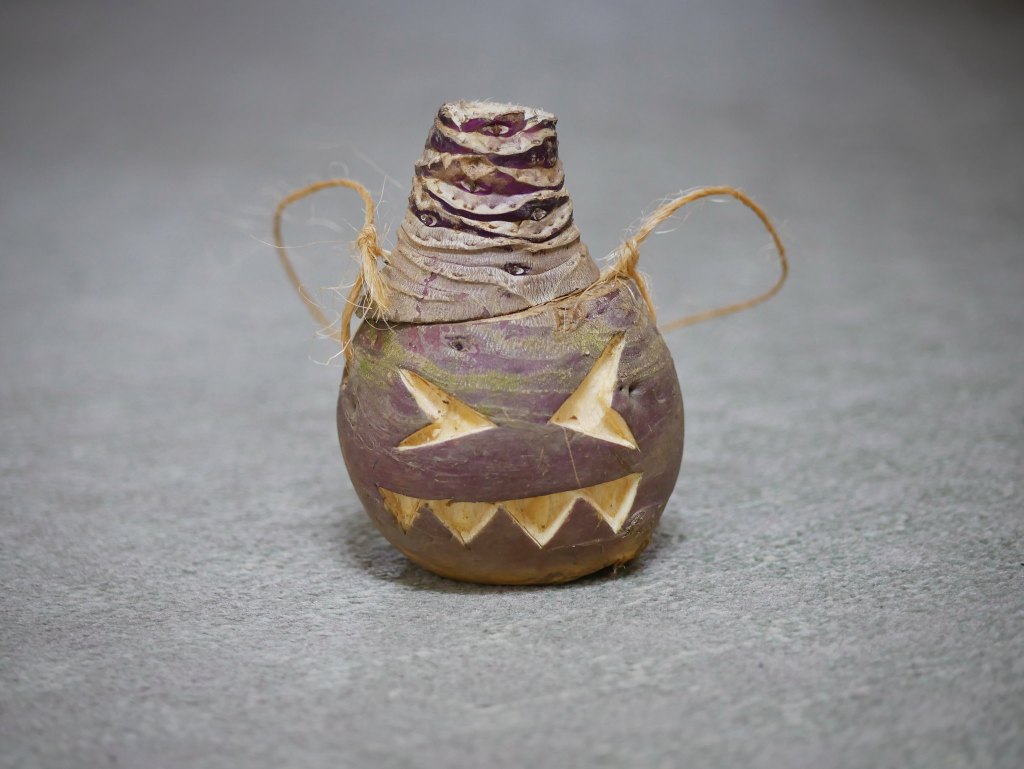
In Ireland, people began carving faces into turnips to ward off Jack’s wandering spirit. When Irish immigrants brought the tradition to America, they found pumpkins to be more plentiful and easier to carve, thus creating the pumpkin jack-o’-lanterns we know today.
Halloween Today
Though Halloween has taken on a more festive tone over the centuries, the spirit of Samhain still lingers. Whether you’re lighting a jack-o’-lantern or enjoying a spooky story, you’re participating in a tradition that stretches back thousands of years. The mystery, community, and storytelling of Samhain remain at the heart of Halloween today.
Further Reading
1. Samhain:
- “Samhain: Rituals, Myths, and Origins of Halloween”: This article from World History Encyclopedia offers a detailed account of Samhain’s historical and cultural significance, along with its impact on modern Halloween traditions. The article is well-cited, providing links to academic sources for deeper exploration.
Link: Samhain: Rituals, Myths, and Origins of Halloween https://www.worldhistory.org/Samhain/
2. Jack-o’-Lantern:
- “The History and Folklore Behind Jack-o’-Lanterns”: Published by Smithsonian Magazine, this article explains the origins of the Jack-o’-Lantern, delving into the Irish folklore of Stingy Jack and the evolution of the pumpkin tradition. The piece includes references to scholarly resources for further reading.
Link: The History and Folklore Behind Jack-o’-Lanterns https://www.smithsonianmag.com/history/history-jack-o-lanterns-168104336/
References
Magazine, Smithsonian. “History, Travel, Arts, Science, People, Places Smithsonian Magazine.” Smithsonian Magazine, 24 Oct. 2024, www.smithsonianmag.com/history/history-jack-o-lanterns-168104336.
Smith, Hillary, and Culture Vannin. “Samhain.” World History Encyclopedia, 24 Oct. 2024, www.worldhistory.org/Samhain.
Vannin, Culture, and Culture Vannin. “Turnip Lantern.” World History Encyclopedia, 24 Oct. 2024, www.worldhistory.org/image/11322/turnip-lantern.
The Editors of Encyclopaedia Britannica. “Samhain | Celtic Harvest, Pagan Rituals and Bonfires.” Encyclopedia Britannica, 20 July 1998, www.britannica.com/topic/Samhain#ref1.
 NLCS Jeju Libraries
Leave a comment