
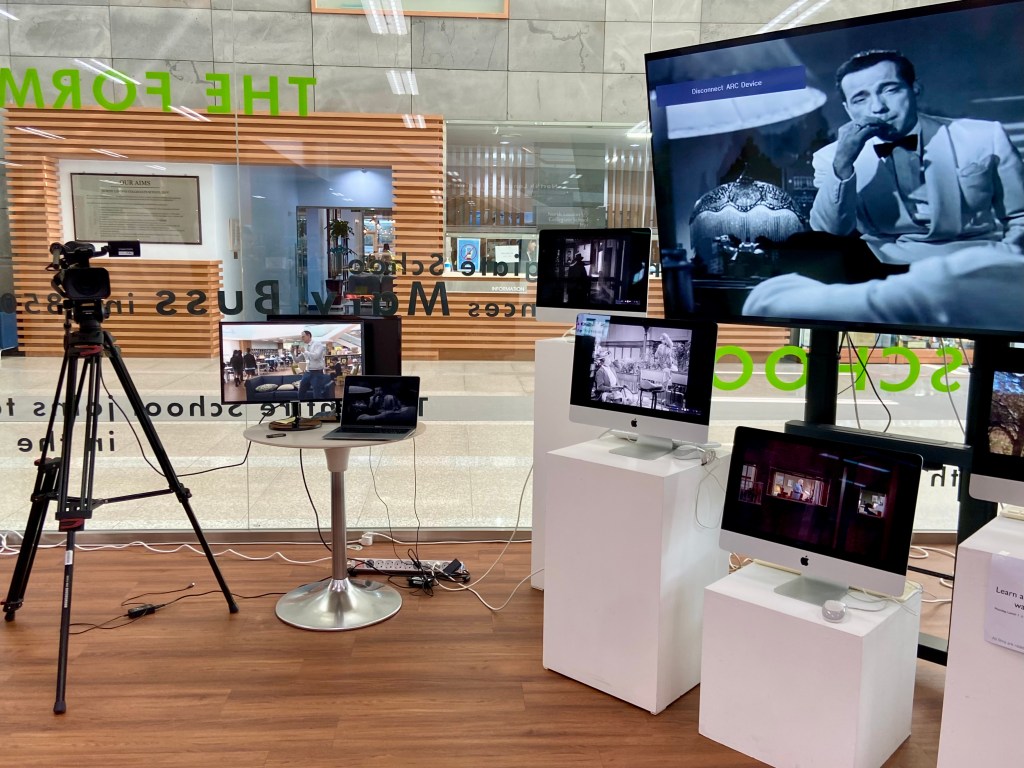
Last week, as part of the Arts Enrichment Week the library hosted a captivating Film exhibition, providing students with a unique opportunity to explore the world of cinematography. From iconic film techniques to hands-on experimentation, this event provided a memorable experience for all.
Film Showcase:
Attendees were treated to a curated selection of critically acclaimed films, showcasing a variety of cinematic styles via the multi-screen installation. This ranged from Western to Film Noir with Butch Cassidy and Double Indemnity, to looking at the work of auteurs such as Jaques Tati with Monsieur Hulot’s Holiday and Orson Welles with Citizen Kane.
Technique Spotlight and Workshop:
Mr Tuffs delved into some of the film-making techniques that each film illustrated; for example, the three-way shot-reverse that Michael Curtiz pioneered in Casablanca or Hitchcock’s fascination with eyes, in this case, exemplified by Rear Window.
Students then had the chance to experiment with high-end cameras and shoot and edit the techniques they had just learned.
Let The Right One In (Alfredson 2008)
This clip from Let The Right One In (Alfredson 2008) is one of the three acts from the film-within-the-film that is set around the Rubik’s cube and the climbing frame.
It has been deliberately supplied without subtitles so that one can focus on the decisions made by the director in the scene. It illustrates the level of detail that goes into planning a scene in a film.
If we look at the cube elements as an example, the flats on the estate are cubes that box-in the courtyard; the square windows (Oskar and Eli’s bedrooms) overlook the cubed climbing frame on which they play with a Rubik’s Cube. Layer upon layer of being trapped, either by the school bullies in Oskar’s case, or in the body of a 12 year old girl in Eli’s case (she happens to be a vampire). The Rubik’s Cube is very clever as it both sets the film in the early 80’s and allows the director to play with colour theory. Red is the vampire’s colour – power, danger, passion and violence. Blue is Oskar’s colour – isolated, melancholy, cold, but also a sign of hope. He is vulnerable in this scene, but note the blue scarf that protects his neck. The vampire is hungry, but he is safe. The white side of the cube and the snow are pure, innocent and add the sense of a beginning…
A question (or three) of detail
- How does the director show the power of the vampire?
- What trick does the director play with the cube to illustrate an exchange of trust and a nod towards the future friendship of Oskar and Eli?
- At the end of the scene with her stomach rumbling, the director hints at the vampire being trapped as a 12 year old – how does he do this?
Answers
1. Power is illustrated in various ways:
- The fact she sits above him
- The stealth of her approach
- She does not seem to feel the cold
- He has to look up, her down
- Use of high overhead camera angle looking down on them
2. The cube trick:
- They exchange each others colours
- He hands her the cube with the white side complete but for a red square – her colour
- She does not move the cube, but when it is handed back that square is blue – his colour
3. Trapped as a 12 year old:
- The actress who looks up at the end of the scene is an older woman
- She also happens to have prominent blue eyes…
 NLCS Jeju Libraries
Leave a comment